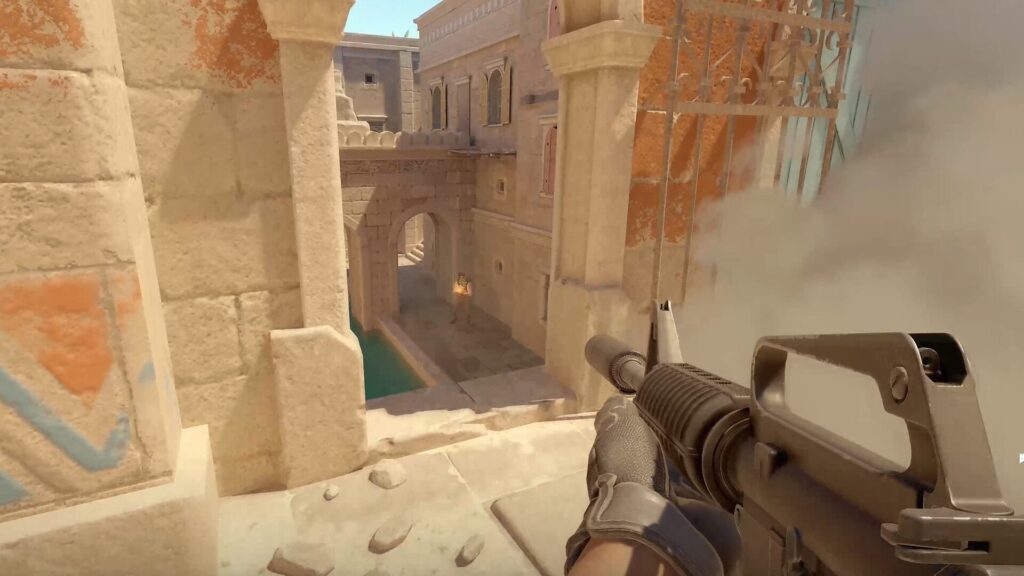
CS2 callouts are the shared spot names on each map (window, banana, heaven, long) that let you tell four teammates exactly where an enemy is, how many, and what they are doing, in under a second. The short answer to “which ones matter”: on every Active Duty map there are roughly 6 to 10 callouts that carry 90% of your useful comms, and learning those beats memorizing the full radar poster. This guide gives you the round-winning callouts per map for the current pool, plus the one table nobody else builds: the same word that means a different place on a different map. Learn these and your comms stop being “he’s kinda there” and start being information your team can act on.
Why callouts actually win rounds
A callout is compression. “One A ramp, one palace, no util” is nine words that tell your whole team where two enemies are, that they haven’t committed utility yet, and that a fast A hit is on the table. Try saying that with your mouse instead. You can’t, and the round is already 300 milliseconds older by the time you finish fumbling for the word.
The honest bit: at the bottom of the ladder callouts barely matter because rounds are decided by whoever clicks heads first. The moment you climb past the middle Premier rating walls, everyone aims, and the thing that separates teams is how fast and how precisely information moves. That is a comms skill, and comms run on callouts. If you want to see where that shift kicks in, we broke it down in our look at the Premier rating walls where comms start deciding rounds. Callouts are also half of a two-part skill: the spot name plus the grenade that owns it. Every callout below has a piece of utility that belongs to it, which is why it pays to pair each callout with the utility that owns that spot as you learn.
One more thing before the maps: you do not need all seven at once. Learn callouts on which maps to one-trick while you climb first, get those to reflex, then expand. A player who knows Mirage and Inferno cold gives cleaner info than someone who half-knows all seven.
Mirage callouts
Mirage is the map everyone queues, so its callouts are the ones you will use most and the ones your teammates will assume you know. The map splits into three lanes (A, mid, B) and the entire mid-round fight revolves around mid control.
The one distinction people get wrong for years: mid versus top mid. Mid is the whole middle lane; top mid is the raised T end by the window and the top boxes, while bottom mid sits down by connector and the CT ramp. Calling “mid” when you mean “top mid” sends the rotation to the wrong end of a very long sightline, and you die alone by ticket wondering why nobody helped.
| Callout | Where it is | Why it matters |
|---|---|---|
| Window | The mid room CTs hold from, overlooking top mid | Controls the whole mid fight; the first smoke of most rounds |
| Top mid | T-side raised end of mid by the boxes | Where T mid control starts; not the same as bottom mid |
| Connector / short | Link from mid to A site (also “short”) | Fastest CT rotate and a common T mid-to-A split |
| Jungle | Raised platform behind A site near connector | Prime CT hold and post-plant angle on A |
| Palace / ticket | T entrance to A (palace) and the ramp below (ticket) | The other half of an A execute; pinch with ramp |
| Ramp / tetris | T ramp up to A and the stacked boxes at its top | Main T entry onto A; tetris is the peek spot |
| Apps / underpass | Apartments into B and the tunnel under mid | B site control and a sneaky mid-to-B rotate |
| Van / sandwich | Cover positions on B site | Standard B post-plant and retake angles |
Inferno callouts
Inferno is a comms map more than a mechanics map, and banana is the center of it. If you learn one callout cluster on this map, make it everything around banana, because roughly half the round’s information lives there.
Banana is the long ramp from T spawn to B site. Top banana is the CT end near sandbags and car; the molotov that lands there is the single most-thrown piece of utility on the map. The rest of Inferno is a series of tight chokes with names you will hear constantly: arch and pit on A, coffins and dark on B, and the mid oranges that almost nobody actually contests but everybody calls.
| Callout | Where it is | Why it matters |
|---|---|---|
| Banana | The long ramp from T to B | The map’s main artery; controlling it is half of B |
| Top banana / car / sandbags | CT end of banana | Where the fight for banana is won or lost; molotov central |
| Arch | Archway on the T approach to A | Key smoke and the pinch point for an A execute |
| Pit | Sunken area on A site by the wall | Off-angle CT hold and a post-plant spot |
| Graveyard | Small area between arch and A | Common lurk and flank timing |
| Coffins / CT | Boxes on B and the CT link into B | B site hold and the CT rotate you cut with a smoke |
| Boiler | Small room connecting banana area to B | Classic lurk and retake angle; check it every retake |
| Oranges | The mid crates (first and second) | Mid control and a flank path most teams ignore |
If any of this is landing, here is the catch: learning callouts fixes your comms, but it does not fix a coinflip queue or the ranked anxiety of grinding the same wall for three weeks. If you would rather the rating move while you keep your good habits, our CS2 Premier boost team plays at the ranks these callouts stop being optional, and can push you through a wall without you having to no-life it. Then you keep queueing with the map knowledge you actually enjoy using.
Ancient callouts
Ancient is a mid-control map, so its most important callouts all cluster around the middle and the two-way donut fight. Win mid on Ancient and you dictate both sites; lose it and you are reacting all round.
The words you will use every round: mid, donut (the ring-shaped cover in mid), cave and tunnel for B, and red or red room for the A approach. Ancient’s callouts are mercifully logical compared to Inferno’s, but “connector” here is not the same connector as anywhere else, which is exactly the trap the cross-map table below is built to catch.
| Callout | Where it is | Why it matters |
|---|---|---|
| Mid | Central lane between the sites | Whoever owns it dictates the whole round |
| Donut | Ring-shaped cover in mid | The mid fight’s key piece of cover and a smoke target |
| Cave | T approach into B | Main B entry; the molotov and smoke spot |
| Tunnel / B tunnel | Route from mid area toward B | CT rotate and a T split option onto B |
| Red / red room | The reddish building on the A approach | Cover on the way to A and a common CT hold |
| House / temple | Structures near A site | A execute cover and post-plant positions |
| Ramp / CT ramp | CT-side ramp linking spawn to sites | Rotate timing; a smoke here buys a lot of time |
| Main | The primary T entrance to a site (A or B specific) | Always pair with the site letter so it is not ambiguous |
Nuke, Anubis, Dust2 and Train callouts
These four round out the current pool, and they range from callout-dense (Nuke has two full floors of names) to callout-friendly (Dust2 is where most of the community learned the vocabulary in the first place). Rather than a table each, here are the essentials that carry your comms on each one.
Nuke is vertical, so half its callouts are about which floor: heaven and hell, ramp and vents, outside and secret. Learn outside, ramp, heaven, hell, vents, squeaky, hut and lobby first, because the entire map fight is about controlling outside and the ramp room, and calling the wrong floor is the classic Nuke griefing move (we have all yelled “he’s on ramp” when we meant vents).
Anubis is water and bridges. The core callouts are mid, water, bridge, canals, connector, heaven, palace and the two mains. Anubis has a heaven that is not Nuke’s heaven and a connector that is not Mirage’s connector, so it is a prime cross-map confusion map for newer players.
Dust2 is the ancestral callout map. Long, long doors, pit, car, catwalk (short), tunnels (upper and lower), mid doors, B platform and xbox are the load-bearing words, and honestly if you have played any CS you already know most of them. The one people still fumble is upper versus lower tunnels, which decides whether your teammate peeks the right box.
Train came back into the pool and got a visual rework, so its callouts are the freshest and the most worth verifying against the current version. Ivy, popdog, connector, ladder room, z (Zed), electrical, alley, main and the trains themselves (bomb train, new box) are the essentials. Because it is newer to a lot of players, Train is where you will hear the most vague comms, and where precise callouts win you the most free rounds. There is a good, long-running r/GlobalOffensive thread on callouts people learned late if you want proof that even veterans miss a few for years.
The same word, a different place: cross-map callout traps
This is the table the callout-poster pages never build, and it is the single biggest source of miscommunication in a mixed-map queue. The same word means a different spot on a different map, so a rotating teammate hears “connector” and pictures the wrong route. Learn callouts per map, not once, precisely because of this.
| Callout | Maps it appears on | Why it confuses people |
|---|---|---|
| Connector | Mirage, Ancient, Anubis, Train | Links different areas on each; the route in your head is probably the wrong one |
| Heaven | Nuke, Anubis (and old maps) | A raised angle on both, but completely different positions |
| Main | Every map | Always A or B specific; “main” alone is half a callout |
| Car | Inferno (top banana), Dust2 (B) | Two different cars, two different sites |
| Pit | Inferno (A), Dust2 (long) | Sunken cover on both, opposite sides of the map |
| Ramp | Nuke, Ancient, Mirage, Train | Vertical link on some, ground route on others |
The fix is boring and effective: whenever a callout is ambiguous, front-load the site letter or a direction. “A connector” and “B connector” leave zero room for the wrong picture. It costs you one syllable and saves you a lost rotation.
Callouts are half the skill: the counter-argument
Now the limitation, because a guide that only sells you the upside is one you should distrust. A perfect callout into no follow-up is just narration. If you call “one A ramp, low HP” and nobody swings to trade, you gave beautiful information and still lost the round. Callouts win rounds only when they are wired to a reaction: someone rotates, someone throws the flash, someone trades the entry.
So do not treat callout memorization as the finish line. It is the prerequisite that makes teamplay possible, not teamplay itself. The reason we still start clients here is simple: we cannot coach trading, timing or util contracts if the team cannot even agree on where things are happening. On orders, the most common comms problem we see at the mid ranks is not silence, it is vagueness. A player around 13 to 14K rating whose aim was completely fine kept calling “he’s there, help,” and his teammates could not help because “there” is not a place. Two sessions of forcing exact callouts, the spot plus the count plus whether they used utility, and the rounds started falling his way. Nothing about his crosshair changed. His words did.
Frequently asked questions
What are callouts in CS2?
Callouts are the shared names for specific spots on each map, like window, banana, heaven and long. They let you tell teammates exactly where an enemy is, how many, and what they are doing in under a second, which is the vocabulary your whole team communicates in.
Do I need to learn callouts to rank up in CS2?
Yes, on any map you queue seriously. At the bottom of the ladder aim carries, but from the mid Premier walls up, fast and precise information decides rounds, and you cannot give fast info without the words. Start with your two most-queued maps and expand from there.
Which CS2 maps are in the Active Duty pool right now?
As of this writing the pool is Mirage, Inferno, Ancient, Nuke, Anubis, Dust2 and Train, with Train having replaced Overpass. Valve rotates the pool at operations and seasons, so check the official Counter-Strike update notes before committing to a long grind.
What is the difference between mid and top mid on Mirage?
Mid is the whole middle lane; top mid is the raised T-side end near the window and the top boxes, while bottom mid sits down by connector and the CT ramp. The distinction matters because a bare “mid” call can send help to the wrong end of a long sightline.
Why do the same callout words mean different things on different maps?
Because maps were built by different designers over decades and the community named spots by feel, not by a global standard. Connector, heaven, main and car all exist on multiple maps and point to different places, which is exactly why you learn callouts per map rather than once.
What is the fastest way to learn a map’s callouts?
Load the map offline with bots, walk every route, and say the callout out loud as you pass each spot. Then review a recent match on Leetify’s map stats, note the two or three areas you keep dying in, and drill the names around those first.
Callouts are the cheapest rating you can buy with study time: learn the 6 to 10 that carry each map, front-load the site letter on anything ambiguous, and wire every call to a reaction so it becomes information instead of narration. Start with your one-trick maps, add a new map’s callouts each week, and your comms will read like a team that has played together for years. And if you would rather keep the good map knowledge but skip the wall grinding, let our CS2 boosting team handle the climb while you queue the maps you actually like.